The EU Green Gardens project, co-funded by the European Union, was launched in Reus with the intention of promoting sustainability, environmental education, and social cohesion. Its development was made possible thanks to the collaboration of the Reus City Council, which provided us with a 1,275 square metre space located within the Boca de la Mina Park. This natural environment, situated in the northern area of the municipality, served as the setting for a series of activities designed to foster intergenerational participation.
The driving group for the project was mainly adolescents and young people between 14 and 21 years old. Some participants regularly attended all sessions, while others signed up specifically for certain workshops. The group consisted of young people with highly varied socio-demographic backgrounds. For example, there were young migrants who were in the process of learning the language, others diagnosed with mental health issues, and we also had a small group of young people with cognitive disabilities. It is important to note that, while the core group was young, participation was broadened to include senior people in the workshops. This experience has shown us how social cohesion is possible and highly beneficial when fostered in nature.
The start of the project was marked by an open session where the objectives were presented and the working methodology was explained. We toured the assigned space with the participants to visualise what would become our community garden and, at the same time, an area for environmental and social learning. From that moment, a calendar of fixed weekly meetings was established: every Tuesday afternoon we met to progress with the different objectives that had been set.
The first few weeks were dedicated to preparing the ground and acquiring basic knowledge. The conditioning tasks were fundamental: we removed weeds, cleaned and aired the soil, and demarcated the areas intended for cultivation. These initial tasks allowed the environment to begin visibly transforming. Meanwhile, the group was developing a dynamic of cooperation.
Once the soil was prepared, a specialised workshop was organised where optimal sowing techniques, the choice of species according to the season, and crop planning were taught. Applying this training, the planting of the first seeds began.
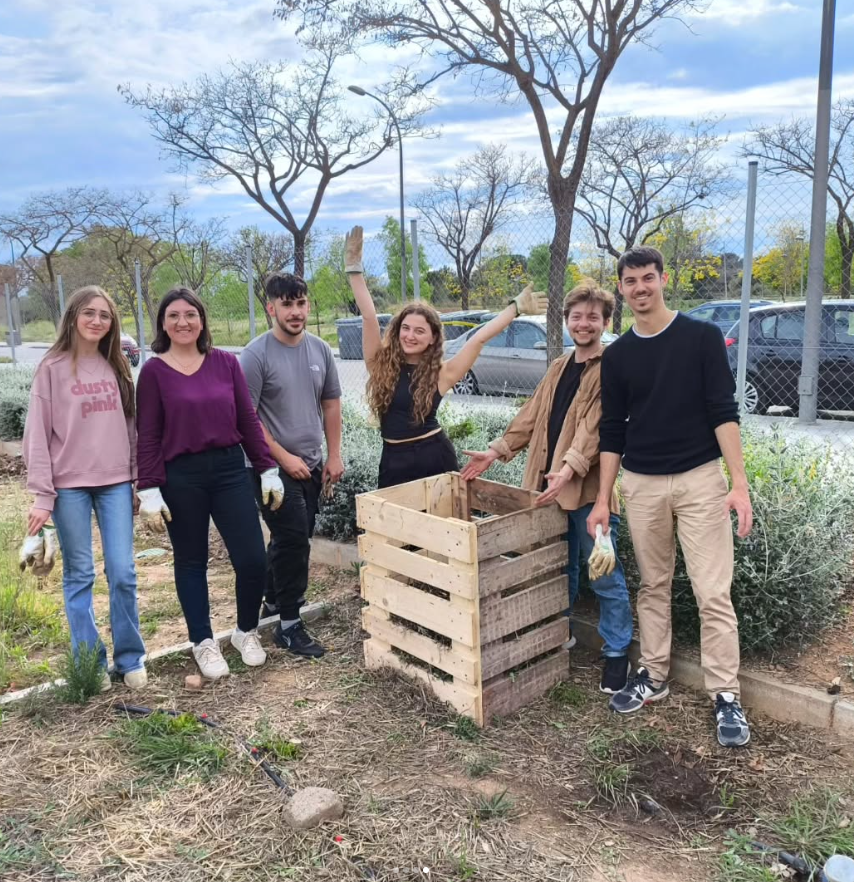
Parallel to the work in the garden, various recreational and educational activities were carried out to strengthen the young people’s bond with the environment. In terms of ecological infrastructure, a community composter was built to transform vegetable waste into fertiliser, which included training sessions on the subject that the youth workers learned in the project's training modules available on the website. An insect hotel was also constructed using recycled materials to promote biodiversity and offer shelter to beneficial species.
Furthermore, a guided excursion was conducted to the Scent Park (Parc de les Olores), where participants discovered different aromatic plants, their properties, and traditional uses. As a practical activity, each young person made a small sachet with a combination of aromas.
The project also included recreational and participatory activities focused on awareness, such as identifying seasonal fruits and vegetables, emphasising the importance of consuming local products. Games were also played to help understand the crucial role of pollinators in ecosystems, as this is a growing problem specifically in the Camp de Tarragona area. In fact, some of these sessions were aligned with days of international recognition, such as World Bee Day, to give the issue greater visibility.
Over the course of the months, the community garden in the Boca de la Mina solidified as a vibrant, well-cared-for, and shared place. However, beyond the physical improvement of the environment, the impact of EU Green Gardens was primarily social, boosting participation, intergenerational cooperation, and environmental awareness.
Thanks to the support of the European Union and the constant involvement of the young people of Reus, the project demonstrated that sustainability can be sown on a small scale and that community work produces tangible benefits both for the land and for the people.
 (1) (1).jpeg)
 (2).jpeg)
.jpeg)